
Standards
ASTM D524 Ramsbottom Carbon Residue
ASTM D524 is the Ramsbottom carbon residue method for petroleum products. The test evaporates and pyrolyzes the sample under controlled conditions and weighs the carbonaceous residue. Laboratories use the number as an indicator of coking tendency — not as a measure of ash, metals, or in-service sludge.
Do not confuse D524 with ASTM D189 (Conradson carbon residue) or with ASTM D482 ash. Ramsbottom and Conradson are related conversations in fuel specs; they are not interchangeable results. D482 burns the sample in air and reports inorganic ash. Sulfated ash (D874) is yet another method, and VeroAsh is a D482 furnace, not a D874 instrument.
This page is original prose and is not a reproduction of the standard. Buy the official text from the ASTM store.
ASTM Standard at a Glance
| Property | Value |
| ASTM Standard | ASTM D524 |
| Type | Test method |
| Measures | Ramsbottom carbon residue |
| Applicable samples | Petroleum products specified for Ramsbottom CCR |
| Related standards | ASTM D189 (Conradson, different method); ASTM D482 (ash) |
| Recommended equipment | VeroRes — Carbon Residue Analyzer |
Related Products
Recommended equipment for ASTM D524:
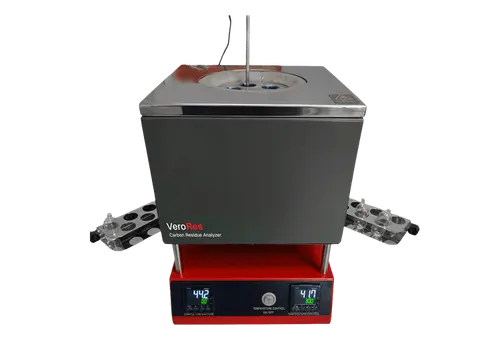
Choosing the right equipment for ASTM D524
Ramsbottom work is a high-temperature coking procedure. Temperature profile, crucible condition, and weighing practice drive repeatability more than the brand name on the oven.
The Vero Scientific carbon residue analyzer (VeroRes) is the instrument linked to this method. If the specification says Conradson (D189), that is a different page and a different procedure.
Frequently Asked Questions
What does ASTM D524 measure?
D524 reports Ramsbottom carbon residue: the carbonaceous leftover after the sample is evaporated and pyrolyzed under the method’s conditions. It is a coking-tendency indicator, not a measure of ash or of in-service sludge.
Is ASTM D524 the same as ASTM D189 Conradson carbon residue?
No. D524 is Ramsbottom. ASTM D189 is Conradson. The numbers are related in industry conversation but they are not the same test. Do not treat a Ramsbottom result as a Conradson result.
Is carbon residue the same as ash?
No. ASTM D482 is ash after combustion in air. Carbon residue is the coke left after controlled pyrolysis. Sulfated ash (D874) is a third method.
Which products are tested with ASTM D524?
Fuels, base stocks, and other petroleum products whose specifications call for Ramsbottom carbon residue. Follow the sample scope in the standard you purchased.
Does Vero Scientific provide equipment for ASTM D524?
Yes. The carbon residue analyzer (VeroRes) is the Vero Scientific instrument for the Ramsbottom D524 workflow.
Get actionable insights and advanced solutions tailored to your industry's needs and technical challenges.
*Submit your email to receive the latest updates and insights from Vero Scientific.