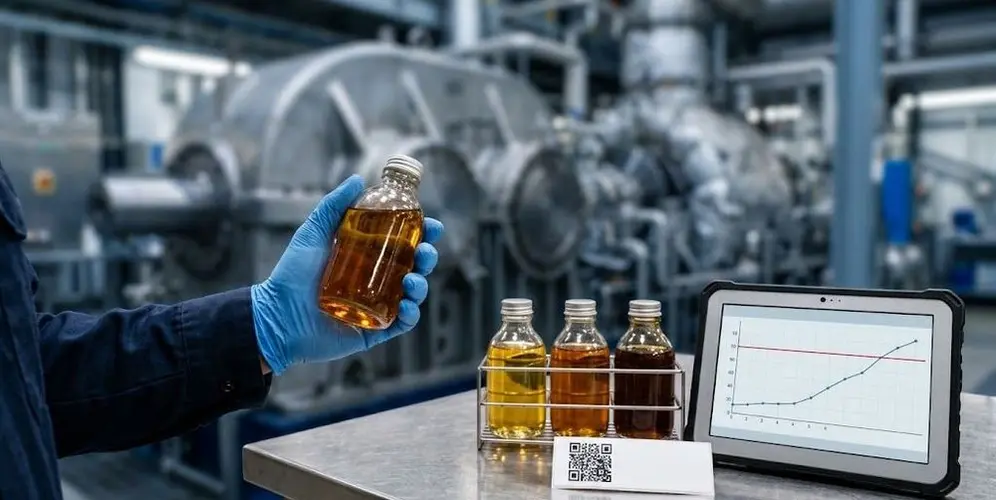
Oil degradation is continuous and cumulative. From the moment a lubricant enters service, heat, oxygen, pressure, metal catalysts, and contamination begin working against it. For QC engineers and lab managers working with petroleum products, two distinct disciplines exist to track that degradation: oxidation stability testing and in-service oil condition monitoring. Both are necessary, but they answer fundamentally different questions, and treating them as interchangeable creates blind spots in both your quality and maintenance programs.
Two Different Questions, Two Different Tools
Before comparing methodology, it's worth being precise about what each approach is actually designed to tell you.
Oxidation stability testing is predictive. It measures how well a fresh oil resists chemical breakdown under controlled, accelerated oxidative stress, giving you a benchmark for how long the lubricant's antioxidant protection will hold before degradation accelerates. This is the question of capability: what is this oil able to withstand?
In-service oil condition monitoring is diagnostic. It examines what has actually happened to the oil during service, measuring accumulated degradation products, tracking shifts in physical properties, and identifying contamination before it causes equipment damage. This is the question of state: what has this oil experienced, and what's left?
The distinction matters operationally. Stability testing belongs at the front of your program, product qualification, supplier approval, incoming inspection. Condition monitoring belongs throughout the asset lifecycle, generating trend data that drives drain intervals, contamination responses, and maintenance decisions. Neither substitutes for the other.
Oxidation Stability Testing: Methods and What They Reveal
The oxidation stability of oil is assessed through standardized bench tests that apply accelerated stress to a fresh sample. The two primary methods are RPVOT and TOST.
RPVOT (ASTM D2272) places the sample in a pressurized vessel with water and a copper catalyst under 620 kPa of oxygen. RPVOT measures an oil's resistance to oxidation directly, whereas most other tests detect byproducts of oxidation that has already occurred. The time to a defined pressure drop is reported as the result: longer means greater antioxidant reserve. The method's main advantage is speed, delivering results in hours rather than the weeks or months TOST requires. Its limitation is reproducibility, test reproducibility is 22%, meaning a result of 2,000 minutes is best represented by a range of 1,560 to 2,440 minutes. That spread is acceptable for comparative screening but rules out using RPVOT alone for precision drain interval decisions.
TOST (ASTM D943) runs oxygen through the sample at 95°C with iron and copper catalysts, measuring time to a defined acid number increase. The conditions are less extreme and more representative of real operating temperatures, but for well-inhibited oils, the test can take months or years to complete. TOST and RPVOT, combined with acid number testing, have traditionally been used together to screen the oxidation stability of turbine oils.
Stability testing is most valuable at these specific decision points: evaluating lubricant candidates before product approval, verifying batch-to-batch consistency from suppliers, confirming OEM specification compliance, and establishing a fresh-oil baseline that in-service results can be trended against over time. What it cannot do is reflect real operating conditions. An in-service lubricant encounters air, heat, pressure, corrosive agents, and other factors that cause chemical changes the bench test never replicates, changes that directly affect the lubricant's ability to do its job.
In-Service Oil Condition Monitoring: What to Measure and Why
Once oil enters service, the monitoring program shifts from predictive to diagnostic. No single measurement tells the whole story, the value is in reading multiple parameters together as a trend. Oil analysis software that keeps each asset's results in one place makes those trends visible without spreadsheet work.
Viscosity is the front-line indicator. As oxidation, nitration, or sulfation occur, condensation products form and cause viscosity to increase, making viscosity measurement essential in any lubricant condition monitoring program. A significant increase points to oxidative thickening or heavy contamination. A drop signals fuel dilution, solvent contamination, or shear degradation of viscosity index improvers. Because viscosity is highly sensitive to temperature, measurement precision matters enormously, small thermal deviations during testing produce results that look plausible but are wrong, and wrong viscosity data fed into a trend program creates false confidence. An oxidation stability analyzer with tight temperature control eliminates the operator-dependent variability that makes manual trending unreliable.
Acid Number (TAN) tracks the buildup of acidic degradation products. In a new lubricant, acid number reflects additive compounding. After time in service, it will begin rising, indicating the creation of acidic degradation products from oxidation, making it a practical measure of fluid service life. TAN tracked alongside viscosity gives a clearer picture of where the oil sits in its degradation curve than either measurement alone.
FTIR Spectroscopy detects the chemical changes that physical property tests miss. Oxidation products in service can lead to increased viscosity, acidity, and formation of sludge and varnish, causing filter plugging, fouling of critical oil clearances, and valve friction. FTIR identifies the carbonyl compounds that signal oxidative breakdown before those consequences materialize, and also flags nitration, sulfation, water contamination, glycol ingress, and additive depletion. The oxidation number from FTIR complements other tests for fluid service life but is generally not used as a primary indicator when all other parameters are within normal limits.
Wear Metal Analysis via elemental spectroscopy adds the equipment health dimension that oil chemistry alone cannot provide. Elevated iron, copper, chromium, or lead concentrations indicate abnormal wear of specific components, allowing intervention before failure. Combined with oil condition parameters, wear metal trending distinguishes between oil-driven and component-driven degradation, a critical distinction for root cause analysis.
Running Both Programs Together
For turbine oil applications, the integration looks like this in practice. At procurement, RPVOT results establish antioxidant reserve and enable comparison between candidate products. Once the oil is commissioned, periodic sampling begins: viscosity, TAN, FTIR, and wear metals on a defined interval, monthly or quarterly for critical assets, or triggered by operating anomalies.
As service hours accumulate, in-service RPVOT results on used samples can be compared against the fresh-oil baseline. The rate of decline indicates how aggressively the antioxidant package is depleting, data that can justify extending or shortening drain intervals based on actual oil condition rather than fixed schedules. Our oil condition monitoring guide covers sampling, alarm limits and trending in detail. Oil analysis has been the backbone of condition-based maintenance for decades, accurate, comprehensive, and well understood by maintenance engineers across every industrial sector. Stability testing sharpens the front end of that program by confirming the oil enters service with the capability to meet the demands placed on it.
The Right Test at the Right Stage
Oil management programs fail not because labs run too few tests, but because they run the wrong tests at the wrong stage, or treat one discipline as a substitute for the other. Oxidation stability testing defines what an oil is capable of under stress. In-service oil condition monitoring tells you what the oil has experienced and how much service life remains.
Structured correctly, the two programs reinforce each other: stability data sets the baseline, monitoring data tracks deviation from it. That combination, applied consistently, with instrumentation precise enough to make the data count, is what separates a reactive oil change program from a genuine condition-based maintenance strategy.
For in-service monitoring after a stability baseline, see the oil condition monitoring system.