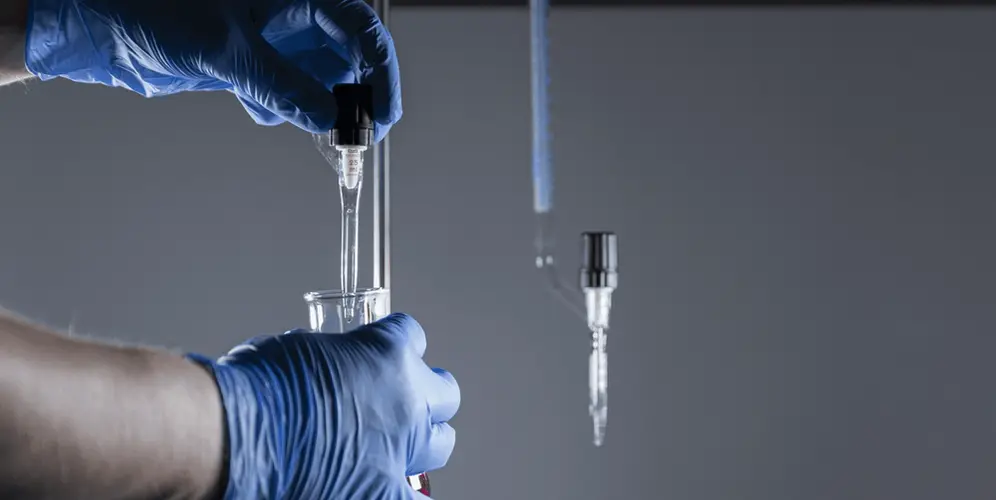
Think of lubricant oil analysis the way a doctor thinks about bloodwork. The oil circulating through an engine, gearbox, compressor, or turbine carries information about everything happening inside that machine, wear, contamination, chemical degradation, and additive depletion. A structured analysis program reads that information before it becomes a failure event.
For quality control engineers and laboratory managers, lubricant analysis is not a reactive tool. Run consistently, it is one of the most cost-effective ways to extend equipment life, validate fluid quality at intake, and defend batch release decisions with traceable data.
What Lubricant Oil Analysis Actually Covers
Most analysis programs organize tests into three categories:
- Lubricant properties. Physical and chemical tests that define the oil's current condition and estimate its remaining useful life. These include viscosity, acidity, oxidation state, and flash point.
- Contamination. Detection of foreign materials that have entered the system: water, fuel, process fluids, dirt, or incompatible lubricants. Identifying the contaminant type usually points directly to the ingress source.
- Wear debris. Characterization of particles generated by mechanical wear, corrosion, or surface fatigue. Particle type, concentration, and size distribution indicate which components are degrading and at what rate.
A complete analysis program draws on all three categories. Testing only viscosity, for example, can miss severe contamination that hasn't yet altered flow characteristics.
Viscosity
Viscosity is the first parameter most labs measure, and for good reason, it has the most direct effect on lubrication film formation. An oil that is too thin fails to separate moving surfaces; one that is too thick causes heat buildup, cavitation, and sluggish cold-start performance.
Kinematic viscosity, measured by ASTM D445 / ISO 3104, is the standard method for most lubricating oils and fuels. The sample flows through a calibrated capillary tube under gravity, and viscosity is calculated from the flow time using the tube's calibration constant. Results are reported in centistokes (cSt) at a defined temperature, 40°C for most industrial oils, 100°C for engine oils.
For in-service oil, a viscosity shift of ±5% from the new oil reference warrants investigation. A shift beyond ±10% is a critical alarm. Viscosity increase typically signals oxidation, soot loading, or contamination with a heavier fluid. Viscosity decrease points to fuel dilution, base oil degradation, or shear of polymer VI improvers.
Rotational (Brookfield) viscometry, described in ASTM D2983, measures absolute viscosity in centipoise and is used specifically for low-temperature testing, critical for qualifying cold-start performance of engine and gear oils.
Total Acid Number (TAN) and Total Base Number (TBN)
TAN measures the concentration of acidic compounds in the oil, expressed as milligrams of potassium hydroxide required to neutralize the acids in one gram of sample (mgKOH/g). A rising TAN indicates oxidative degradation or acid contamination. It is one of the primary markers for determining when an in-service oil has reached the end of its useful life.
TBN applies to engine oils, which contain alkaline additives designed to neutralize combustion acids. As these additives deplete, TBN falls. When TBN drops below a defined threshold, typically 50% of the new oil value, the oil's capacity to protect against acid corrosion is compromised.
Interpreting TAN in isolation can be misleading. A moderately elevated TAN in an oil with no viscosity change, no FTIR oxidation peak, and stable additive concentrations may not indicate imminent risk. TAN should always be read alongside other oxidation indicators before drawing conclusions.
Fourier Transform Infrared Spectroscopy (FTIR)
FTIR analysis scans the oil's infrared absorption spectrum to identify chemical changes that aren't visible through physical testing alone. It detects oxidation byproducts, nitration (common in natural gas engines), soot, water, glycol, fuel dilution, and additive depletion, all from a single measurement.
For condition monitoring programs, FTIR is typically used to track changes over time rather than as an absolute pass/fail test. A developing oxidation trend, for example, appears as a growing absorption peak at a specific wavenumber long before viscosity or TAN values reach alarm thresholds. That lead time is what makes the test valuable.
Elemental Analysis
Inductively coupled plasma (ICP) spectroscopy and atomic emission spectroscopy (AES) quantify metal concentrations in parts per million. The results serve two purposes:
- Wear metal detection. Iron, copper, lead, chromium, tin, and aluminum are the most common wear indicators. Each corresponds to specific component materials: iron to ferrous machine surfaces, copper to bearings and bushings, lead to bearing overlays. Rising concentrations signal accelerating wear.
- Additive monitoring. Zinc, phosphorus, calcium, magnesium, and boron are typical additive elements. Tracking their depletion confirms whether the oil's protective chemistry is still functional.
Elemental analysis has a limitation: it only captures particles small enough to remain suspended in solution, generally below 5-10 microns. Larger wear particles, which often indicate more severe wear mechanisms, require particle counting or ferrography.
Particle Counting and Ferrography
Particle counting quantifies solid contamination by size distribution and is reported as an ISO cleanliness code (ISO 4406). It is the primary method for monitoring hydraulic and turbine oil systems, where particulate contamination directly drives component wear.
Ferrography takes the analysis further by separating particles from the oil using a magnetic field, then examining them under a microscope. The morphology of wear particles, their shape, surface texture, and composition, distinguishes between normal rubbing wear, cutting wear, fatigue spalling, and corrosive wear. This level of detail is particularly useful when elemental analysis shows elevated metals but does not clarify the wear mechanism.
Flash Point
Flash point is the lowest temperature at which vapors from the oil ignite when exposed to an open flame. It is measured by ASTM D92 (Cleveland Open Cup) or ASTM D93 (Pensky-Martens Closed Cup), depending on the fluid type.
A significant drop in flash point, typically more than 20–30°C below the new oil specification, is a reliable indicator of fuel dilution in engine oils. It is also a safety parameter for storage and handling classification. For quality control at intake or during blending, flash point is a standard acceptance criterion.
Water Content
Water in oil is one of the most damaging contaminants a lubricated system encounters. Even concentrations below 0.1% can accelerate oxidation, promote bacterial growth in certain fluids, cause hydrogen embrittlement in steel components, and disrupt additive chemistry.
Karl Fischer titration (ASTM D6304) is the standard quantitative method, capable of detecting water at concentrations as low as a few parts per million. Crackle testing provides a rapid qualitative screen, a small drop of oil on a hot plate produces crackling if free or emulsified water is present. For systems with known water ingress risk, Karl Fischer testing should be part of every routine sampling event.
Oxidation Stability
Oxidation stability tests assess how resistant an oil is to chemical degradation at elevated temperatures in the presence of oxygen. ASTM D943 (Turbine Oil Oxidation Stability Test) and ASTM D2272 (Rotating Pressure Vessel Oxidation Test, or RPVOT) are the most widely used methods.
RPVOT results are reported as time-to-pressure-drop in minutes. A significant decline in RPVOT value for an in-service oil, compared to the new oil baseline, indicates that the antioxidant package is depleted and the oil is approaching the end of serviceable life. This test is particularly relevant for turbine, hydraulic, and compressor oils operating at high temperatures for extended drain intervals.
Cloud Point and Pour Point
These two parameters define the low-temperature performance limits of a lubricant. Cloud point is the temperature at which wax crystals begin to form, causing the oil to appear hazy. Pour point is the lowest temperature at which the oil remains pourable.
Both are relevant for oils used in cold climates or refrigeration applications and are standard acceptance criteria in many industrial and fuel oil specifications. For procurement teams qualifying lubricant suppliers, cloud and pour point data should be requested as part of the technical data sheet package.
Building an Analysis Program That Works
Vero Scientific designs measurement and analysis instrumentation built specifically for the demands of oil, fuel, and liquid analysis. Selecting the right fuel oil testing equipment, instrumentation that delivers accurate, repeatable results across the full range of required tests, is the foundation of a reliable program.
The value of lubricant oil analysis scales with consistency. Single-point data tells you what the oil looks like today; trending data across multiple samples tells you where it's heading and how fast. Labs that establish baseline values on new oil, sample at defined intervals, and track results over equipment life get the most diagnostic value from their programs. Running the core tests as on-site oil analysis cuts the wait for results from days in transit to the length of the test itself. For a step-by-step setup, see our guide to building an oil condition monitoring program.
For in-service programs, see the oil condition monitoring system and the oil analysis equipment catalog.