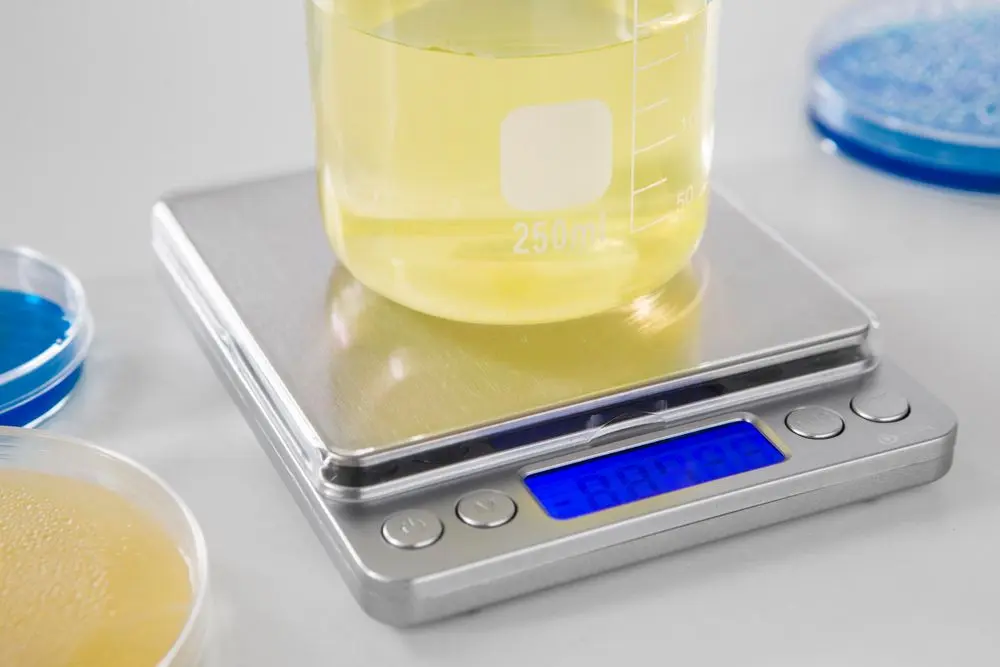
Kinematic viscosity is among the most routinely tested properties in petroleum product analysis. It directly affects how a lubricant or fuel performs under real operating conditions: how well it forms a protective film, how it flows at startup, how it handles load and heat. ASTM D445 is the standard that governs how this measurement is made, and understanding it properly matters for anyone responsible for product quality, equipment reliability, or specification compliance.
What Is Kinematic Viscosity?
Kinematic viscosity is a measure of a fluid's resistance to flow under gravity. More precisely, it's the time required for a fixed volume of fluid to flow through a calibrated capillary at a controlled temperature, converted to standard units using the viscometer's calibration constant. For when a rotational instrument is the better choice, see rheometer vs viscometer.
The result is reported in millimeters squared per second (mm²/s), which is equivalent to centistokes (cSt). Critically, a viscosity reading is only meaningful when accompanied by the temperature at which it was measured. Reporting viscosity without temperature is like reporting a pressure reading without units. For petroleum products, the standard reference temperatures are 40°C and 100°C.
Kinematic viscosity is distinct from dynamic (absolute) viscosity. Dynamic viscosity, measured in mPa·s or centipoise (cP), reflects the fluid's internal resistance when an external force drives the flow. Kinematic viscosity is gravity-driven and does not involve an applied external force.
The two are related through the fluid's density:
Dynamic viscosity (cP) = Kinematic viscosity (cSt) × Density (g/cm³)
For Newtonian fluids with stable density, this conversion is straightforward. For used oils and formulated lubricants, the relationship is more complicated. More on this below.
ASTM D445: Scope and Purpose
ASTM D445, Standard Test Method for Kinematic Viscosity of Transparent and Opaque Liquids (and Calculation of Dynamic Viscosity), defines the procedure for measuring kinematic viscosity of petroleum products and related liquids using calibrated glass capillary viscometers.
The ASTM D445 kinematic viscosity standard applies to a wide range of petroleum products: fuels, base oils, lubricating oils, hydraulic fluids, gear oils, and other hydrocarbon-based liquids. The method covers transparent and opaque samples.
Results from ASTM D445 feed directly into other critical determinations, including viscosity index calculation per ASTM D2270, ISO viscosity grade classification, and SAE grade verification.
It is also the reference method for kinematic viscosity data used in fuel and lubricant specifications globally. When data from alternative test methods (such as ASTM D7042) conflicts with ASTM D445 results, the D445 value takes precedence for specification purposes.
How the Test Works
A sample flows through a calibrated glass capillary viscometer under gravity at a tightly controlled temperature, and the flow time is recorded. Kinematic viscosity is then calculated by multiplying the flow time by the viscometer's calibration constant.
Several viscometer types are defined in the standard: Ostwald-type, suspended-level, and reverse-flow capillaries. That’s to accommodate different sample types and viscosity ranges. Reverse-flow capillaries are specifically required for opaque liquids, since the flow timing marks cannot be observed through the fluid.
Temperature Control
Temperature is the dominant variable in kinematic viscosity measurement. The ASTM D445 kinematic viscosity standard requires temperature control within ±0.02°C for the range of 15°C to 100°C, and ±0.05°C outside that range. Meeting this requires a temperature-controlled bath with a verified external thermometer.
Equilibration time before measurement is equally important. The standard recommends approximately 30 minutes for the charged viscometer to reach thermal equilibrium in the bath, though the optimal time varies by instrument, temperature, and viscosity range.
Sample Preparation
Transparent petroleum samples must be homogenized and degassed (typically in an ultrasonic bath) before testing. If fibers or particulates are present, filtration through a 75 µm screen is required. Particulate contamination is one of the most common sources of measurement error in kinematic viscosity testing: particles in the sample restrict flow through the capillary, and dust or residue inside the capillary from inadequate cleaning between tests has the same effect.
Opaque liquids and residual fuel oils require additional preparation: heating and stirring to achieve homogeneity, followed by filtration through a preheated filter. The use of reverse-flow capillaries for these samples is mandatory.
All measurements are performed in duplicate, with cleaning steps between runs. The standard specifies acceptable repeatability and reproducibility limits. Results outside these limits indicate a measurement problem that must be resolved before reporting.
ASTM D445 Kinematic Viscosity in Petroleum Products: Why It Matters
Product quality verification
Every lubricant and fuel specification includes kinematic viscosity limits. A product outside its viscosity grade at 40°C or 100°C fails specification, regardless of how other parameters look. ASTM D445 provides the reference measurement against which those limits are evaluated.
Fitness for service assessment
For in-service oil analysis, viscosity trending over time reveals critical changes: oxidative thickening, thermal degradation, dilution by fuel or solvent, or water contamination. A viscosity increase of 10% above the new oil baseline is a common threshold for investigating or changing oil. A decrease of similar magnitude suggests contamination or shear degradation of VI improver additives.
Viscosity index determination
Kinematic viscosity at both 40°C and 100°C is required to calculate viscosity index per ASTM D2270. The accuracy of that calculation depends entirely on the accuracy of the D445 measurements. Errors at either reference temperature compound into an incorrect VI result.
Base stock and formulation evaluation
Formulators and quality managers use ASTM D445 kinematic viscosity data to evaluate base oil consistency, batch-to-batch variation, and the effect of additive packages on finished lubricant viscosity.
Kinematic vs. Dynamic Viscosity: A Practical Distinction
Most off-site analysis laboratories report kinematic viscosity. Most onsite instruments measure dynamic viscosity and apply a conversion algorithm to report the result in cSt.
For new, clean, single-grade mineral oils, the conversion between kinematic and dynamic viscosity using measured density is reliable. The fluid behaves as a Newtonian fluid, meaning viscosity is constant regardless of shear rate, and density is stable.
Used oils are often non-Newtonian. Several common conditions produce this behavior:
- VI improver additives. The polymer molecules in multigrade oils respond differently to shear than the base oil. At high shear rates, these molecules align and the oil temporarily thins. This shear-thinning behavior means the fluid's apparent viscosity depends on how it's being measured.
- Water contamination. When water emulsifies into oil, it creates a non-Newtonian suspension. Counterintuitively, emulsified water typically increases measured kinematic viscosity, even as it reduces the fluid's actual film-forming ability. A kinematic viscosity reading in this condition can be misleading.
- Oxidation and thermal degradation by-products. Insoluble degradation products suspended in the oil create a colloidal suspension, further departing from Newtonian behavior.
- Soot. Particularly in diesel engine oils, soot forms a colloidal suspension that increases kinematic viscosity while behaving non-Newtonianly under shear.
For non-Newtonian fluids, the kinematic viscosity reading may not accurately reflect the oil's ability to form a protective film under operating shear conditions. Dynamic viscosity, measured at a defined shear rate, is technically a more direct indicator of film thickness.
However, because ASTM D445 kinematic viscosity data is what lubricant specifications and most oil analysis programs are built on, it remains the standard reference parameter for quality and condition monitoring decisions.
Where both kinematic and dynamic viscosity data are available analysts should resist trying to force perfect agreement between them. For example, when an onsite dynamic viscometer supplements laboratory testing.
Instrumentation and the Role of Automation
A kinematic viscometer used for ASTM D445 testing must meet specific requirements for timing accuracy (±0.07%), temperature stability, and capillary calibration traceability. Manual glass capillary setups can meet these requirements. However, they can introduce operator-dependent variables: timing consistency, cleaning thoroughness, and equilibration discipline.
Automated systems eliminate much of this variability. Automated timing, controlled sample introduction, and integrated washing routines reduce the influence of individual technique on results.
Regardless of instrument type, capillary calibration must be maintained using certified viscosity reference standards, and cleaning protocols must prevent cross-contamination between samples.
What Reliable Kinematic Viscosity Data Enables
Accurate ASTM D445 testing is the foundation for a wide range of downstream decisions. Laboratories that treat it as a routine, low-attention test often discover measurement variability they hadn't accounted for when troubleshooting unexpected results.
Getting kinematic viscosity right is controlling temperature precisely, preparing samples consistently, maintaining clean and calibrated equipment, and understanding the limits of what the measurement tells you.
Vero Scientific designs precision measurement technologies that support the accuracy and repeatability that ASTM D445 kinematic viscosity testing demands. Contact us to learn how our solutions support oil and fuel analysis programs across laboratories, refineries, and industrial QC facilities.
For the instrument used in this method, see the automatic kinematic viscometer.