Every petroleum lab tests viscosity. It appears on certificates of analysis, drives lubricant grade selection, and sits at the center of most oil condition monitoring programs. Yet the specific measurement behind that number, kinematic viscosity, is frequently misapplied or misread. Understanding what it actually captures, and where it falls short, leads to better decisions at every stage from product qualification to in-service oil analysis.
What Is Kinematic Viscosity?
At its core, kinematic viscosity describes how readily a fluid moves under its own weight. No pump, no spindle, no applied pressure, just gravity pulling a fluid through a calibrated glass capillary tube. The measurement itself is time-based: a fixed volume of fluid is released into the tube, and the seconds it takes to travel a defined distance are recorded. Multiply that time by the tube's calibration constant and you have the kinematic viscosity.
Results are expressed in centistokes (cSt), or equivalently in mm²/s. Standard petroleum testing reports this value at 40°C, at 100°C, or at both when viscosity index calculation is needed. A raw cSt figure without a temperature reference is analytically meaningless, the same oil will read very differently at different temperatures, so the two values are inseparable.
The dominant test method is ASTM D445, the international benchmark for kinematic viscosity in petroleum products. It underpins grading systems, product specifications, and quality release procedures across the industry.
Dynamic Viscosity vs Kinematic Viscosity
Both terms appear on lab reports and instrument specs, and they're regularly conflated. The distinction matters more than most people realize, particularly when reconciling results between a laboratory and an onsite testing instrument.
Dynamic viscosity, also called absolute viscosity, measures a fluid's internal resistance when an external mechanical force drives flow. A motor-driven spindle, a pressurized capillary, a controlled pump: these generate the force, and the fluid's resistance to that force is the measurement. The unit is centipoise (cP).
Kinematic viscosity removes the density variable by expressing flow resistance relative to the fluid's own weight. Mathematically, it's dynamic viscosity divided by density. For a fluid with known, stable density, converting between the two is routine arithmetic.
The complication is that density isn't always stable. In used oil analysis, contamination and degradation both alter density. When that happens, kinematic viscosity and dynamic viscosity diverge, and the kinematic number can give a misleading picture of the oil's actual condition. Dynamic viscosity governs lubricating film thickness and surface protection. Kinematic viscosity is a practical proxy for it, but the proxy only holds when density assumptions remain valid.
This is why results from a laboratory kinematic viscometer and an onsite dynamic viscometer rarely align exactly. Most onsite instruments measure dynamic viscosity and estimate kinematic viscosity by holding density constant in their algorithm. That algorithm is an approximation. Treating the two as interchangeable leads to confusion; treating each instrument's output as its own trend line, benchmarked against its own new-oil baseline, gives reliable condition data. For a comparison with rotational instruments, see rheometer vs viscometer.
Kinematic Viscosity of Oil: Behavior in Service
Finished lubricating oils, hydraulic fluids, and turbine oils are Newtonian fluids. Their viscosity doesn't depend on how fast they flow or how hard you push them, at a given temperature, the number is the number. This predictability is exactly what makes kinematic viscosity a practical specification parameter for these products.
Temperature is the primary variable. As oil heats up, molecules move more freely and internal resistance drops. As it cools, resistance increases. This temperature sensitivity is quantified by the viscosity index, a higher VI means viscosity changes less across a temperature range, which is valuable in applications exposed to wide thermal swings.
In service, several conditions push kinematic viscosity of oil away from its new-oil baseline in ways that signal a problem:
- A rising viscosity reading typically points toward oxidation, where heat and oxygen exposure generate heavy by-products that thicken the oil. It can also indicate water contamination, when water emulsifies into oil rather than separating as a free phase, the resulting mixture behaves more viscously than the base oil alone, which can mask the contamination rather than flag it.
- A falling viscosity reading is more immediately dangerous. Fuel dilution in engine applications is the most common cause, thinning the oil below the grade minimum and reducing its ability to maintain a protective film between moving surfaces. Shear degradation of polymer additives produces the same result in multigrade oils.
A ±10% shift from the new oil baseline at the same reference temperature is a common industry threshold for flagging a sample for investigation. That number alone doesn't tell you the cause, but it tells you something has changed.
Kinematic Viscosity of Crude Oil
Crude oil occupies a different position in this discussion because its composition varies more widely than any finished product. Depending on source, light condensates may have kinematic viscosities below 5 cSt at 40°C, while some heavy crudes exceed tens of thousands of cSt at the same temperature. The spread reflects fundamental differences in molecular weight, wax content, and dissolved gas.
For pipeline operations, getting kinematic viscosity right at multiple temperatures is an engineering requirement. It determines pump sizing, heating system design, flow assurance strategy, and blend ratios when streams from different sources are combined. Getting it wrong translates directly into energy costs, capacity limitations, or, in extreme cases, lines that gel and stop moving.
Heavy and waxy crudes introduce an additional complexity: at temperatures approaching pour point, they can exhibit non-Newtonian behavior, with viscosity rising sharply and flow characteristics becoming difficult to predict from a single kinematic measurement. Standard ASTM D445 testing remains the reference for crude characterization, but for heavy crude applications it's often supplemented with additional low-temperature flow testing.
Kinematic Viscosity of Engine Oil
Engine oil viscosity grades follow the SAE J300 classification system, and the high-temperature grade designation, the "30," "40," or "50" in a multigrade label, is defined by kinematic viscosity limits at 100°C. An oil labeled 5W-40 must fall within a specific cSt range at that temperature to carry that designation. The lower limit protects against thinning under operating heat; the upper limit prevents excessive drag and oil consumption.
Where engine oil departs from a simple Newtonian model is in its additive chemistry. Multigrade oils use viscosity index improver polymers, molecules that coil tightly at cold temperatures and expand at high temperatures to offset viscosity loss. These polymers make the oil mildly shear-sensitive: under the high shear rates present inside a running engine, the effective viscosity is lower than the kinematic viscosity measured under the low-shear conditions of ASTM D445.
This gap is why high-temperature high-shear (HTHS) viscosity exists as a separate specification. HTHS measures viscosity under conditions designed to simulate those in engine bearings during operation. Kinematic viscosity at 100°C confirms the oil meets its grade. HTHS viscosity predicts how it actually behaves where lubrication is most critical. Both matter; neither replaces the other.
For used engine oil analysis, kinematic viscosity at 100°C is the standard monitoring parameter. A drop below the grade minimum indicates fuel dilution or polymer shear-down. A climb above the maximum suggests oxidative thickening. Either deviation prompts further investigation before the next scheduled drain interval.
Getting Accurate Results: What the Measurement Demands
Kinematic viscosity is highly sensitive to temperature. A deviation of even 0.5°C at the test temperature can shift the result enough to affect interpretation, which is why bath temperature stability is not optional, it's the foundation of a valid measurement. Capillary selection also matters: each tube covers a specific viscosity range, and flow times outside the method's valid window produce unreliable results regardless of how careful the analyst is.
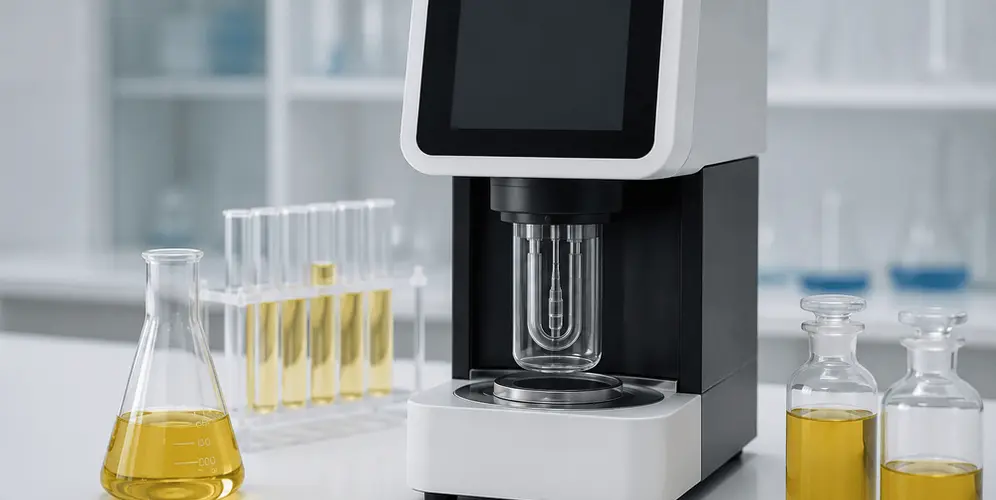
In high-throughput environments, maintaining that level of control manually across dozens of daily samples is difficult. An automatic kinematic viscometer addresses this directly, automated sample handling, temperature control to 0.01°C, and flow timing to 0.001 seconds eliminate the variability that accumulates in manual workflows. For labs where throughput and audit-readiness are both priorities, automation is worth evaluating seriously.
One Number, Many Decisions
Kinematic viscosity underpins product grading, batch release, incoming material inspection, used oil condition monitoring, pipeline flow modeling, and crude blending decisions. It's the same measurement serving very different analytical purposes, which is why understanding it precisely, not just using it by rote, changes the quality of the decisions it informs.
A result that's in spec confirms a product. A result that's shifted from baseline tells a story. Reading that story accurately depends on knowing what the measurement captures, what affects it, and where its limits are.
Vero Scientific develops precision measurement instruments for petroleum and liquid analysis applications. Contact our team to learn how our solutions can support your lab's kinematic viscosity testing requirements.