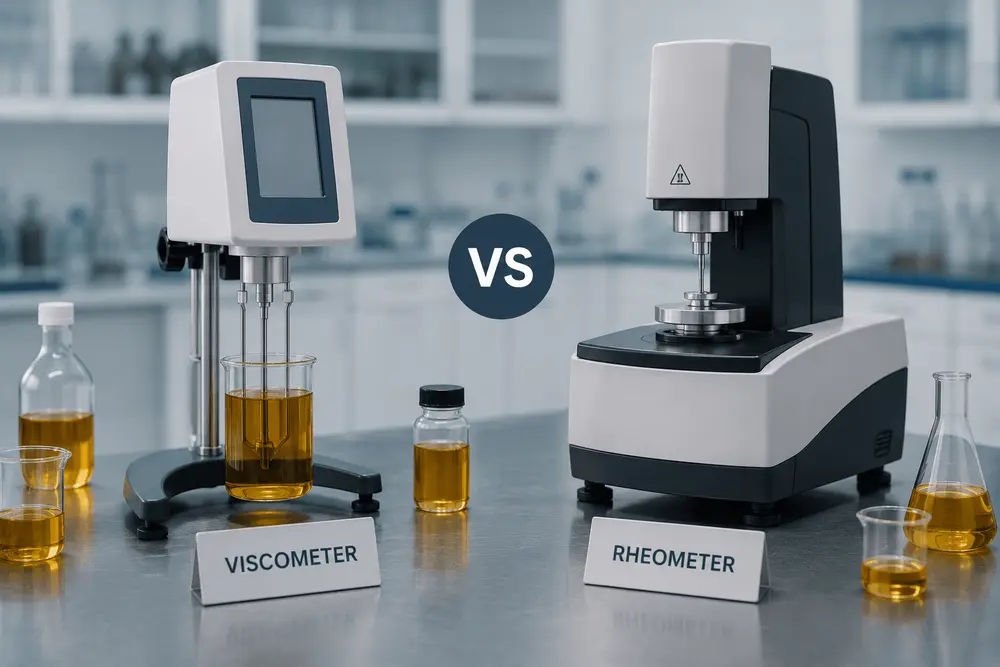
Walk into most petroleum QC labs and you'll find a viscometer running. Walk into a polymer R&D facility and you're more likely to find a rheometer. The fact that both instruments measure fluid flow doesn't mean they're interchangeable, and in oil testing specifically, the difference has direct consequences for data quality, compliance, and operational cost.
Here's what actually separates them, and how to determine which one belongs in your workflow.
The Core Job Each Instrument Does
A viscometer has one purpose: quantify how much a fluid resists flowing. It produces a viscosity value at a specific temperature and shear rate. That's the output. For the kinds of fluids petroleum labs deal with daily, base oils, finished lubricants, hydraulic fluids, marine fuels, this is precisely what testing standards call for, and precisely what process decisions are built around.
Rheometers operate on a different premise. They're designed for materials that don't behave the same way twice, where viscosity shifts depending on how fast you stir, how long you apply force, or how the material has been handled. A rheometer doesn't just measure flow resistance; it maps how a material responds across a full range of mechanical conditions: varying shear rates, oscillatory stress, temperature sweeps, time-dependent recovery. It treats the material as a system to characterize, not a specification to confirm.
That distinction, confirmation versus characterization, is the real dividing line between these instruments.
Why Petroleum Fluids Are a Special Case
Most oils and fuels are Newtonian fluids. This means their viscosity is consistent regardless of how fast they flow or how much mechanical force is applied. Stir a gear oil slowly or quickly, and the viscosity reads the same. This property is what makes single-point viscosity measurements meaningful for these products.
Capillary viscometers, which time how long a fluid takes to travel through a precision glass tube under gravity, are the standard method for kinematic viscosity measurement in petroleum testing. ASTM D445 and ISO 3104 are built on this principle. Refineries, blenders, and quality labs around the world rely on these methods for batch release, incoming inspection, and specification compliance. The data format is recognized, the method is auditable, and the results map directly onto product grade limits.
A rheometer produces fundamentally different data. It can calculate viscosity, but that's a secondary output for an instrument primarily designed to measure elastic modulus, yield stress, and viscoelastic behavior, properties that petroleum Newtonian fluids don't meaningfully exhibit. Applying a rheometer to routine kinematic viscosity testing is like using a mass spectrometer to check whether a container is full: technically capable, practically unnecessary, and costly in the wrong direction.
Where Rheometers Do Belong in Petroleum Work
This isn't to say rheometers have no place near oil testing. Several petroleum-adjacent applications depend on them.
Asphalt and bitumen are genuinely non-Newtonian. Their behavior changes dramatically with temperature and load duration, which is exactly why Dynamic Shear Rheometers are specified in AASHTO performance-grading standards for pavement binders. A single viscosity number cannot predict how asphalt will perform under thermal cycling or repeated traffic loading. The rheometer's ability to apply oscillatory stress and measure elastic recovery is what makes it appropriate here.
Grease, despite being petroleum-based, is also non-Newtonian. It has a yield stress, a threshold force it requires before it starts to flow, and its structure can break down and recover under shear. Measuring grease with a standard viscometer produces misleading or incomplete data. Rheological testing gives formulators the information they need to predict pump-ability, bleed rate, and structural stability.
Polymer-modified lubricant development is another relevant context. When engineers are formulating new products, testing viscosity index improver concentrations, evaluating additive interactions, they often need to understand how formulations behave across a range of shear conditions before committing to a production specification. That's R&D work, and rheometers are built for it.
The pattern is clear: rheometers belong in formulation, development, and testing of complex or structured materials. Viscometers belong in production QC of finished, specification-driven petroleum products.
A Practical Comparison
| Viscometer | Rheometer | |
| Primary output | Kinematic or dynamic viscosity | Viscosity, elasticity, yield stress, viscoelasticity |
| Best-fit fluids | Newtonian oils, fuels, base stocks | Non-Newtonian: grease, asphalt, polymer blends |
| Standards alignment | ASTM D445, ISO 3104 | AASHTO T315, specialized rheological methods |
| Typical environment | QC lab, production facility | R&D, formulation, advanced materials testing |
| Operator requirement | Moderate | High, results require rheological interpretation |
| Infrastructure needs | Standard lab setup | Air-bearing models need clean compressed air supply |
| Capital cost | Lower | Substantially higher |
Automation and Throughput: The Practical Dimension
For labs processing significant sample volumes, whether a refinery running multiple shifts or a QC facility managing supplier qualification testing, throughput is often as important as measurement capability. Automated viscometer platforms address this directly.
An automatic kinematic viscometer like the VeroVis handles sample loading, temperature equilibration, timing, and tube cleaning with minimal operator involvement. Temperature is controlled to 0.01°C resolution; flow timing to 0.001 seconds. Results meet ASTM requirements without manual intervention between samples. For labs where analyst time is constrained and batch turnaround matters, that level of automation has concrete operational value.
Rheometers, by contrast, are not high-throughput instruments for routine testing. Each measurement run requires more setup, more interpretation, and more operator judgment. The data they generate is richer, but in a QC context, richer isn't always better. Specification compliance doesn't require structural analysis; it requires an accurate, repeatable number delivered on time.
Common Decision Errors, and How to Avoid Them
Two mistakes come up repeatedly when labs are selecting viscosity measurement equipment.
The first is buying a rheometer for QC use because it seems like the more capable instrument. Capability without relevance adds cost and complexity without improving outcomes. A rheometer running kinematic viscosity tests on finished lubricants isn't producing better data than a properly calibrated viscometer, it's just producing more expensive data.
The second error is the reverse: relying on a viscometer for materials where flow behavior is fundamentally more complex. If your lab is doing formulation work, testing polymer-modified products, or evaluating any fluid whose properties shift under varying stress, a viscometer will give you a number that doesn't represent the full picture. Decisions made on that data carry real risk.
The starting point for any instrument selection should be the nature of the material, not the appeal of the technology.
Precision Starts with the Right Question
A viscometer answers: does this product meet its viscosity specification? A rheometer answers: how does this material behave across a range of mechanical conditions?
For oil testing in refinery, QC, and industrial lab settings, where Newtonian fluids, established test standards, and throughput requirements define the environment, the viscometer is the appropriate tool. It delivers accurate, auditable, method-compliant results efficiently, which is exactly what production-grade quality control demands.
Rheometers earn their place in formulation labs and R&D environments where understanding material behavior matters more than confirming a specification. Many mature operations run both: viscometers handling daily QC, rheometers supporting technical development. That split reflects a clear-eyed understanding of what each instrument is actually for.
Vero Scientific builds precision measurement solutions for the specific demands of oil and fuel analysis. To find out which viscosity testing platform fits your operation, reach out to our team.
For oil and lubricant viscosity testing, see the automatic kinematic viscometer.