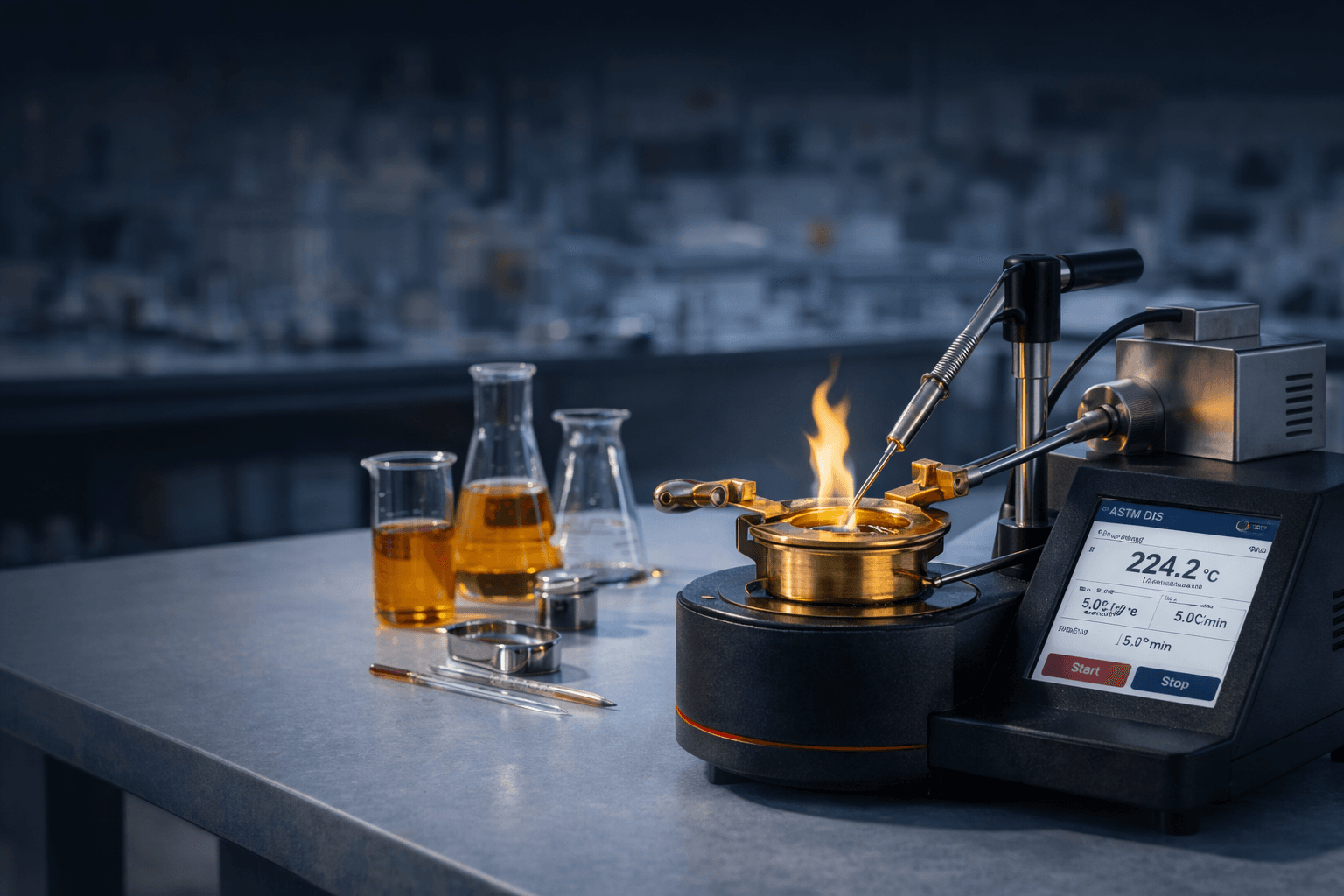
ASTM D93 establishes the standard test method for determining flash point using the Pensky-Martens closed cup tester. This method is critical for petroleum product safety classification, quality control, and regulatory compliance across refineries, fuel manufacturers, and testing laboratories worldwide.
The flash point represents the lowest temperature at which a petroleum product produces sufficient vapor to form an ignitable mixture with air when exposed to an ignition source. This measurement directly influences how products are stored, handled, transported, and classified under hazardous materials regulations.
Why ASTM D93 Matters for Petroleum Testing
Flash point testing serves as a fundamental safety parameter in the petroleum industry. Products with lower flash points present higher fire hazards and require more stringent handling protocols. The closed cup method specified in ASTM D93 provides precise, repeatable measurements that support critical operational and compliance decisions.
Safety Classification and Transport Regulations
Flash point data determines whether petroleum products are classified as flammable or combustible materials. This classification affects packaging requirements, shipping documentation, storage facility design, and handling procedures. Regulatory agencies worldwide rely on ASTM D93 results for enforcement of safety standards.
Quality Control and Contamination Detection
Changes in flash point measurements can indicate contamination by more volatile materials. For instance, gasoline contamination in diesel fuel or engine oil produces measurable flash point reductions. Regular testing helps identify quality issues before products reach customers or cause equipment problems.
Product Specification Compliance
Petroleum product specifications routinely include minimum flash point requirements. Testing verifies that materials meet these specifications and ensures consistency across production batches. This verification protects both manufacturers and end users from performance issues and safety risks.
Temperature Range and Application Scope
ASTM D93 covers an exceptionally wide temperature range from 40°C to 370°C, making it the only closed cup flash point test procedure that extends to such high temperatures. This broad range accommodates diverse petroleum products from volatile fuels to heavy lubricating oils and specialty materials.
For biodiesel testing specifically, automated Pensky-Martens apparatus can determine flash points in the range of 60°C to 190°C. The method's versatility makes it applicable across multiple product categories while maintaining consistent testing protocols.
Determinations above 250°C are possible, though precision data has not been established beyond this temperature. For most petroleum products, the specified range provides adequate coverage for typical flash point values encountered in commercial applications.
Three Testing Procedures for Different Products
ASTM D93 defines three distinct procedures tailored to different petroleum product characteristics and testing requirements.
Procedure A: Distillate Fuels and Lubricating Oils
This procedure applies to distillate fuels including diesel, biodiesel blends, kerosene, heating oil, and turbine fuels. It also covers new and used lubricating oils and other homogeneous petroleum liquids that flow readily and heat uniformly during testing.
Using manual apparatus, operators maintain stirring at 90 to 120 rpm while the sample temperature increases at 5 to 6°C per minute. The timing of ignition source application depends on expected flash point. For samples with expected flash points at or below 110°C, the ignition source is applied at temperature intervals that are multiples of 1°C, beginning when the sample reaches 23°C below the expected flash point.
For samples with expected flash points above 110°C, ignition source application occurs at each 2°C temperature increase, starting 23°C below the expected flash point. When testing materials with expected flash points exceeding 130°C, best practice involves applying the ignitor every 10°C throughout heating until the sample temperature reaches 28°C below the expected flash point.
Procedure B: Residual Fuels and Viscous Materials
Procedure B addresses residual fuel oils, cutback residua, used lubricating oils, and petroleum mixtures containing solids. This procedure also applies to materials that form surface films during testing or possess such high kinematic viscosity that they cannot be uniformly heated under Procedure A conditions.
The key difference lies in stirring rate and heating protocol. Manual apparatus operates with stirring at 250 rpm, significantly faster than Procedure A. The heating rate is controlled to produce temperature increases of 1 to 1.6°C per minute, much slower than Procedure A. These adjustments ensure uniform heating and accurate flash point determination for viscous or heterogeneous samples.
Procedure C: Biodiesel with Electronic Detection
Procedure C employs automated apparatus with electronic flash detection for biodiesel (B100) testing. The stirring rate matches Procedure A at 90 to 120 rpm. The ignition source is applied at temperature intervals that are multiples of 2°C, beginning approximately 24°C below the expected flash point.
Electronic detection systems provide objective, repeatable flash identification without operator judgment variability. This automation improves consistency and allows laboratories to process higher sample volumes with reduced labor requirements.
Manual vs. Automated Testing Equipment
ASTM D93 accommodates both manual and automated Pensky-Martens closed cup apparatus. Each approach offers distinct advantages depending on laboratory requirements, testing volume, and available resources.
Manual systems require continuous operator attention throughout testing. Operators control heating rates, apply the ignition source at specified intervals, observe for flash occurrence, and record results. While manual testing demands more labor, it provides flexibility for unusual samples or troubleshooting applications.
Automated systems manage the entire test sequence electronically. These instruments control heating rates precisely, apply ignition sources at programmed intervals, detect flash occurrence through optical or electronic sensors, and record results automatically. Automation improves repeatability, reduces operator variability, and increases throughput in high-volume testing environments.
Modern automated flash point testers integrate with laboratory information management systems, enabling seamless data transfer and comprehensive record-keeping. This connectivity supports regulatory compliance requirements and quality assurance programs by documenting all test parameters and environmental conditions.
ISO 2719 vs ASTM D93
Both ISO 2719 and ASTM D93 specify Pensky-Martens closed cup flash point testing, and the methods share fundamental principles. However, important differences exist that affect result comparability and method selection.
The primary distinction involves heating rates and ignition source application protocols. ASTM D93 Procedure A specifies heating rates of 5 to 6°C per minute for most applications, while ISO 2719 requires heating at 5 to 6°C per minute for expected flash points below 110°C and 2 to 3°C per minute for higher flash points.
Ignition source application timing also differs between the standards. ASTM D93 provides detailed guidance for different expected flash point ranges with specific temperature intervals for ignitor application. ISO 2719 uses slightly different protocols that can affect when the flash point is detected during the test sequence.
Temperature correction procedures represent another area of difference. Both standards account for atmospheric pressure effects on flash point measurements, but the correction formulas and application guidelines vary slightly between ASTM D93 and ISO 2719.
For laboratories serving international markets or comparing results across different regions, understanding these distinctions becomes critical. Many laboratories maintain capabilities for both methods to accommodate customer requirements and regulatory specifications in different jurisdictions.
When selecting between methods, consider your primary customer base, applicable regulatory requirements, and existing laboratory accreditations. Many petroleum product specifications explicitly state which method must be used, eliminating the choice and requiring strict adherence to the cited standard.
Precision and Limitations
ASTM D93 provides detailed precision statements covering reproducibility and repeatability under specified conditions. These precision values help laboratories assess measurement uncertainty and determine if results from different testing occasions or facilities agree within acceptable limits.
Important limitations apply to certain product types and temperature ranges. Precision for residual fuels has not been determined for flash points above 100°C. Similarly, precision data for used lubricating oils remains unavailable across the full temperature range. Some product specifications cite ASTM D93 minimum flash points below 40°C, but precision has not been established below this temperature.
Implementing ASTM D93 in Your Laboratory
Successful implementation of ASTM D93 requires appropriate fuel testing laboratory equipment, trained personnel, and robust quality control procedures. Selection between manual and automated apparatus depends on testing volume, product mix, and available resources.
Choose apparatus that covers your typical flash point range and accommodates your sample types. Automated systems offer advantages for high-throughput operations testing primarily distillate fuels and lubricants. Manual systems provide flexibility for diverse sample types including viscous materials and products requiring Procedure B protocols.
Ensure your selected equipment meets all ASTM D93 specifications for temperature control accuracy, stirring mechanisms, ignition source characteristics, and safety features.
Proper training ensures operators understand the method's critical aspects including sample preparation, heating rate control, ignition source application timing, flash detection criteria, and safety protocols. Even with automated equipment, operators must recognize normal system operation and identify potential issues requiring corrective action.
Implement control charting for reference materials to monitor system performance over time. Participate in proficiency testing programs to verify that your results align with other qualified laboratories.
Maximizing Testing Value
ASTM D93 flash point testing delivers maximum value when integrated into comprehensive quality control programs. Combine flash point data with other critical measurements like viscosity, sulfur content, and distillation characteristics for complete product characterization.
ASTM D93 remains the definitive method for closed cup flash point determination across the petroleum industry's diverse product range. Understanding the method's procedures, selecting appropriate equipment, and implementing rigorous quality controls ensures that flash point testing supports safety, quality, and regulatory compliance throughout petroleum product lifecycles.