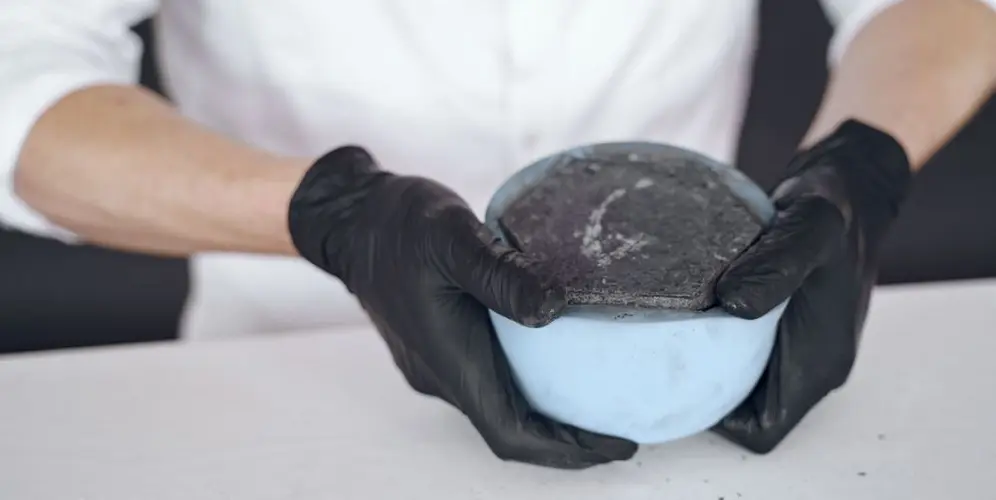
Ash in petroleum products is the inorganic, non-combustible residue left behind after a fuel sample is completely burned. It is not a single compound with a single source. It is the sum of whatever mineral and metallic contamination was present in the fuel before combustion, and those contaminants can enter at almost any point in the supply chain.
Storage tank corrosion introduces iron and rust particles. Seawater ingress during marine transport brings sodium. Crude oil itself carries naturally occurring metals, vanadium, calcium, magnesium, that concentrate through refining. Inadequate filtration during transfer passes all of it downstream.
The metals most commonly associated with ash formation in petroleum fuels are sodium, vanadium, calcium, iron, and magnesium. Each behaves differently during combustion. Vanadium forms pentavanadate compounds that melt at high temperatures and deposit as hard, adherent crusts on internal equipment surfaces.
What ASTM D482 Covers
ASTM D482 is the standard test method for determining ash content in the range of 0.010% to 0.180% by mass in petroleum products, specifically in distillate and residual fuels, gas turbine fuels, crude oils, lubricating oils, and waxes where ash-forming material is considered a contaminant rather than an additive.
That last distinction is worth stating clearly. D482 applies to products free from intentionally added ash-forming additives, including certain phosphorus compounds. For additivated lubricating oils or used crankcase oils, where metallic additives are part of the formulation, ASTM D874 (Sulfated Ash) is the correct method. Using D482 on additivated products will produce results that are neither accurate nor interpretable under the standard's precision limits.
The current active version is ASTM D482-19, developed by ASTM Subcommittee D02.03. It is among the most widely referenced ash testing methods across the petroleum industry, and its measurement range covers the ash levels relevant to the vast majority of fuel and base oil applications.
How the Test Works
The procedure is not complicated, but it is unforgiving of shortcuts. Reliable results depend on consistent execution at every step.
Sample preparation begins with thorough mixing. For mobile samples, ten minutes of manual or mechanical shaking is sufficient to achieve homogeneity. Viscous or solid materials must be heated until fully liquid before mixing. If a sample cannot be homogenized after repeated attempts, it is rejected, there is no meaningful ash result from an inhomogeneous specimen.
Ignition and controlled burning come next. The sample is placed in a crucible, ignited, and burned at a moderate, controlled rate on a hotplate or gas burner until only ash and residual carbon remain. Water-containing samples present a spattering risk during this stage; operators must use appropriate PPE, and any test portion that escapes the crucible due to spattering is discarded and the test repeated, sometimes with a small volume of isopropanol added to support ignition.
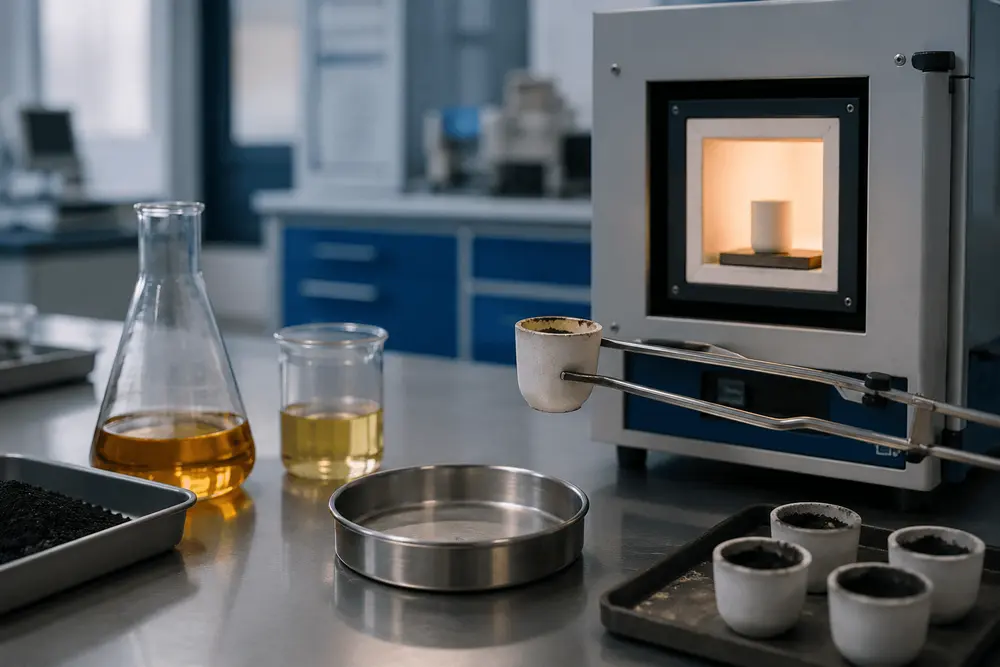
Muffle furnace ashing completes the combustion. The carbonaceous residue is transferred to a muffle furnace held at 775°C ± 25°C, where it is held until all remaining carbon is fully oxidized to CO₂ and all mineral salts are converted to their oxide forms. The furnace must have front and rear apertures to maintain natural airflow through the chamber, this is what drives complete oxidation rather than partial conversion.
Calculation is applied to the cooled, weighed residue:
Ash (% by mass) = (mass of ash ÷ mass of sample) × 100
Results for low-ash fuels are reported to three decimal places.
Equipment the Method Requires
The standard defines the apparatus precisely, and the defined specifications exist for good reason, deviation from them affects the result. The core ash testing equipment required under ASTM D482 consists of four items:
- Crucible or evaporating dish, platinum, silica, or porcelain construction; 90–120 mL capacity. Must be chemically inert at test temperatures and free from surface contamination carried over from previous tests. Degraded or contaminated crucibles must be replaced before use.
- Electric muffle furnace, capable of maintaining 775°C ± 25°C with front and rear apertures for passive airflow. Temperature control is the single largest variable in this test. A furnace that drifts outside calibration tolerance will either leave residual carbon in the ash, overstating the result, or cause loss of volatile ash components, understating it.
- Analytical balance, resolution to 0.1 mg. At sample masses of 1 gram or less, a 1 mg weighing error translates directly to a 0.1% error in the reported result, potentially the difference between a passing and failing specification.
- Mechanical shaker or high-speed mixer, required for samples that do not homogenize readily by hand, particularly residual fuels and heavy crude fractions.
Of these, the muffle furnace, or ash content furnace, is where most precision failures originate. A furnace that holds temperature reliably and consistently across its working volume is not interchangeable with one that does not, and in a high-throughput lab, the difference shows up in repeatability data before it shows up in a compliance failure.
Where D482 Is Applied
The method's applicability across a wide range of petroleum materials means it shows up across equally varied testing contexts.
Refineries and marine fuel suppliers run D482 routinely as part of product release protocols for residual fuel oils, which are particularly susceptible to elevated ash due to the concentration of metals and solids during vacuum distillation and blending. For diesel fuels, ASTM D975 specifies a maximum ash content of 0.01% by mass, and D482 is the method used to verify compliance with that limit.
Gas turbine operators test incoming fuel for ash content to protect combustion chambers and hot section hardware. A single batch of high-ash fuel burned through a turbine does not necessarily cause immediate damage, but the cumulative effect of ash deposition on nozzle guide vanes and turbine blades shows up in efficiency losses and unplanned inspection findings.
Crude oil characterization programs use ash data to understand the inorganic burden of incoming feedstocks, information that directly affects hydroprocessing catalyst life and refinery equipment maintenance planning.
Procurement functions use D482 results for vendor qualification, incoming inspection, and contract enforcement. When energy content and cleanliness are contractual parameters, the test result is the basis for acceptance or rejection of a shipment.
Reading an Elevated Result
A result above specification is not the end of the analysis, it is the beginning of a diagnostic process. The total ash percentage tells you something is wrong. The metal profile of the ash tells you what and, often, where.
High sodium points to seawater or brine contamination, a recurring issue in marine fuel handling and coastal storage. Vanadium-heavy ash indicates residual fuel oil with high natural metal content, and signals a specific corrosion risk to high-temperature alloy components. Elevated iron and rust particles point to storage tank degradation or pipeline corrosion upstream of the sample point.
For QC engineers, this is the value of running D482 consistently rather than selectively. A single high result is a flag. A trend of rising ash content across sequential batches from the same supplier, or across the same storage tank over time, is actionable intelligence about a systemic problem in the supply chain or storage infrastructure.
Precision Limits and What They Demand
ASTM D482 specifies repeatability of 0.003% and reproducibility of 0.008% at the 95% confidence level for residual fuels in the 0.005–0.180% ash range. These are tight limits, and meeting them consistently requires more than following the procedure once correctly.
In high-throughput QC environments where the same equipment runs dozens of tests per week across multiple operators and shifts, process discipline is what keeps results within the method's stated precision. Equipment quality sets the ceiling; operator practice determines whether you reach it.
At Vero Scientific, we design measurement and analysis solutions for the facilities where these demands are highest, refineries, QC laboratories, and incoming inspection operations where every result needs to be defensible, traceable, and right the first time. Contact our team today to learn how Vero Scientific's instrumentation supports fuel quality testing programs.