Corrosion is rarely dramatic until it's already caused a problem. A hydraulic system develops a blockage. A fuel line degrades ahead of schedule. A copper fitting fails in a system where failure is expensive. In most of these cases, the damage traces back to a fluid that was never properly screened for corrosive properties.
ASTM D130 exists to catch that problem before it reaches the equipment. It's one of the most widely used tests in petroleum product quality control, and understanding how it works, and how to read its results correctly, is essential for anyone responsible for fuel or lubricant qualification.
What ASTM D130 Actually Tests
ASTM D130 measures the corrosive effect of hydrocarbon-based fluids on copper. The test applies to a broad range of petroleum products: aviation fuels, diesel, gasoline, lubricating oils, hydraulic fluids, gear oils, and associated additives. Any product that comes into contact with copper or copper alloy components in downstream equipment is a candidate for this test.
The reason copper is used as the test medium is practical, copper is present throughout industrial fluid systems. It appears in heat exchanger tubes, fuel system fittings, hydraulic valve bodies, and bearing housings. Copper alloys are also common in marine and aerospace applications. If a fluid is aggressive toward copper under controlled lab conditions, it will cause problems in service.
The test is required or referenced by a wide range of international fuel and lubricant standards, making ASTM D130 compliance a routine requirement for product certification, supplier qualification, and quality assurance programs.
The Test Procedure, Step by Step
The method is straightforward, but each step matters for result validity.
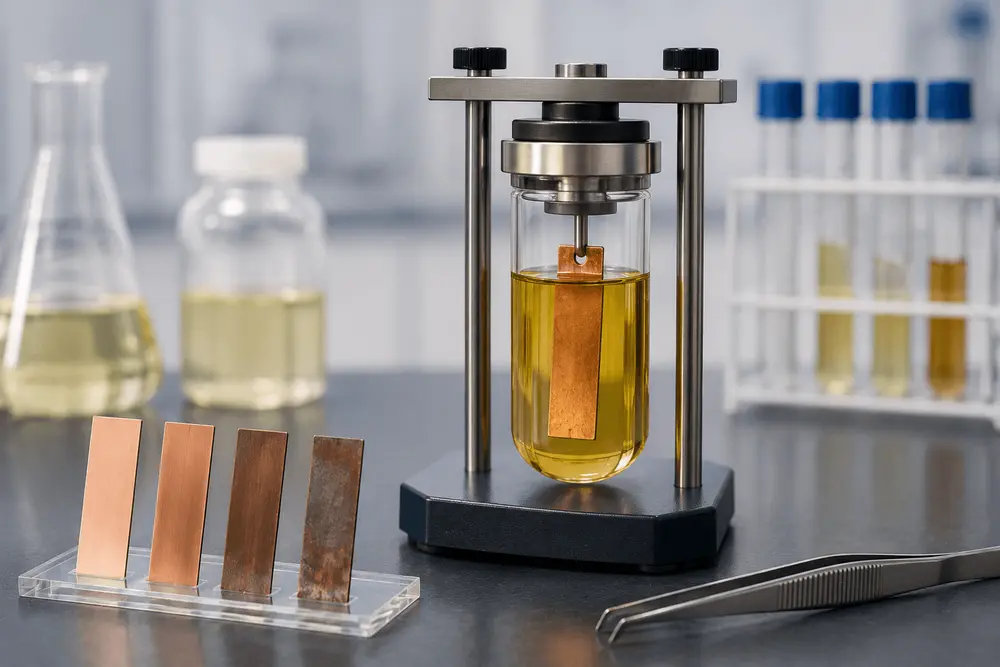
A copper strip is cut to specification and polished to remove surface oxides, then cleaned to ensure a bare, consistent metal surface. Any residual contamination or oxidation at this stage will affect the result.
The prepared strip is then fully submerged in the fluid sample inside a sealed container. Sealing the container is important, it prevents oxidation from ambient air from influencing the strip's condition during the test.
Testing conditions are product-dependent. The temperature and duration of immersion vary based on the type of fluid being evaluated. Lubricating oils are typically tested at higher temperatures and longer durations than fuels, reflecting their actual service environments. Following the correct conditions for the product type is not optional, deviation will produce results that don't correspond to the standard's rating scale.
After the immersion period, the strip is removed, rinsed, and examined visually. The surface appearance is compared directly against a set of standardized reference strips published by ASTM, and the result is assigned a classification based on that comparison.
Reading the Rating Scale
ASTM D130 uses a four-group classification system. Within each group, sub-ratings capture finer distinctions:
Class 1
Slight Tarnish The strip shows a light change from its original copper color. At 1a, this is a faint orange tint barely distinguishable from the polished surface. At 1b, the tarnish is slightly deeper but still within acceptable limits for most applications.
Class 2
Moderate Tarnish Discoloration becomes more pronounced. This group covers a wide visual range, from darker oranges and reds through purples, silvers, and into yellows and greens. Sub-ratings 2a through 2e capture these variations.
Class 3
Dark Tarnish The strip shows significant discoloration in the pink-to-red-to-brown range, often with some yellow or green tones depending on the specific corrosion chemistry.
Class 4
Corrosion The surface is severely altered, blackened, graphite-colored, or showing chalky deposits. This rating indicates that the fluid is actively corrosive and unsuitable for use in systems containing copper components.
For most applications, Class 1 ratings are fully acceptable, Class 2 requires evaluation against the specific product specification, and Class 3 or 4 results are cause for rejection.
Where Color Interpretation Gets Complicated
The rating scale looks like a simple progression from light to dark, but the reality is more nuanced, and this is where classification errors most often occur.
The ASTM D130 color scale is not a linear sequence. It's derived from a three-dimensional color model where multiple hues, saturations, and intensities interact. Corrosion color depends on the specific chemistry of both the fluid and the copper strip, which means real samples don't always produce the clean, distinct colors shown in reference charts.
Some rating groups are monochromatic and relatively easy to classify. Group 1 stays in the orange family. Group 4 is defined by blacks and grays with minimal variation. Groups 2 and 3, however, are polychromatic, they encompass reds, purples, silvers, yellows, and greens in varying combinations. This creates genuine ambiguity at certain transition points.
The most frequently confused transitions are 1a/1b (difference is lighting-sensitive), 1b/2a (orange versus orange-with-a-red-undertone), 2b/3a (brownish hues deepen gradually), and 3b/4a (distinguishing dark brown from early-stage severe corrosion on uneven surfaces). At these boundaries, two analysts examining the same strip can reach different conclusions, not because one is wrong, but because the classification genuinely sits between categories.
This is worth knowing whether you're conducting manual visual assessment or interpreting results from an automated imaging system. In either case, understanding that ratings describe a spectrum rather than discrete, unambiguous categories produces better interpretive decisions.
Why This Test Has Operational Significance
ASTM D130 is not a research tool, it's a front-line quality screen. In a refinery, blending facility, or QC lab, it answers a specific question before product leaves: will this fluid corrode the copper components it contacts in service?
The consequences of a missed corrosion problem accumulate quietly. Corrosive fluid attacking copper surfaces generates metal particles that contaminate the system, deposit on critical surfaces, and accelerate wear elsewhere. In hydraulic systems, even minor copper degradation changes valve clearances and seal compatibility. In fuel systems, copper compounds can destabilize the fuel itself, affecting combustion characteristics and injector deposits.
Catching this early, at the testing stage, costs far less than diagnosing it after equipment damage has occurred. That's the operational case for routine ASTM D130 testing, and why procurement specifications for fuels and lubricants almost universally include a corrosion rating requirement.
Equipment and Bath Conditions
Consistent results depend on tightly controlled test conditions. A copper corrosion test bath maintains the sample at the required temperature throughout the immersion period. Temperature stability is non-negotiable, viscosity, reactivity, and the rate of corrosion-driving chemical reactions all shift with temperature. A bath that cycles or drifts will produce variability that looks like a material difference when it's actually a measurement artifact.
Glassware, solvent quality for strip cleaning, and handling technique also affect results. A strip contaminated by fingerprints or inadequately polished will show tarnish that has nothing to do with the test fluid. Good laboratory practice around sample preparation is as important as the test itself.
Putting ASTM D130 Results to Work
A single ASTM D130 result tells you whether a specific batch of fluid, at a specific test condition, caused tarnish or corrosion on copper. That's useful for batch release. Over time, tracking results across production batches or suppliers builds a more complete picture of product consistency and supplier reliability.
For procurement specialists, a certificate showing a Class 1 ASTM D130 result is a meaningful quality indicator, but it's worth confirming which test conditions were used. Temperature and duration vary by product type, and a result obtained under one set of conditions doesn't necessarily validate the product under another.
For lab managers evaluating their testing protocols, ASTM D130 is one of the easier methods to standardize and automate. The procedure is well-defined, the rating system is established, and reference standards are commercially available for method verification.
Corrosion You Can See Before It Costs You
What makes ASTM D130 valuable is the directness of what it tells you. A copper strip immersed in your product and compared to a reference scale gives a concrete, auditable answer about corrosive potential. Done correctly and interpreted carefully, it protects equipment, validates suppliers, and supports specification compliance without ambiguity.
For labs running high volumes of petroleum product testing, having the right equipment and a clear understanding of the rating system is what separates reliable QC from guesswork.
Vero Scientific supports petroleum and fuel testing labs with precision measurement solutions designed for demanding QC environments. Contact our team to learn how our instruments can support your oil and fuel analysis programs.